The AI Analyst: What It Means for Investment Teams in 2026
AI can automate sourcing, CRM and diligence drafts to boost coverage—investors must retain valuation, underwriting and committee control.
My take: AI helps investment teams cover more work, but people still own every capital decision.
If I strip the article down to its core, the message is simple:
- AI is best used as a controlled workflow layer
- It can scan, sort, draft, track, and update records
- People still need to approve outreach, meetings, CRM changes, and investment calls
- The main risks are stale data, made-up claims, scoring drift, and data security
- The safest rollout starts with low-risk admin work, then moves into reviewed tasks
In plain terms, I’d use AI to cut time spent on sourcing admin, market scans, follow-ups, meeting prep, and portfolio checks. I would not let it decide valuation, underwriting, downside cases, or committee recommendations on its own.
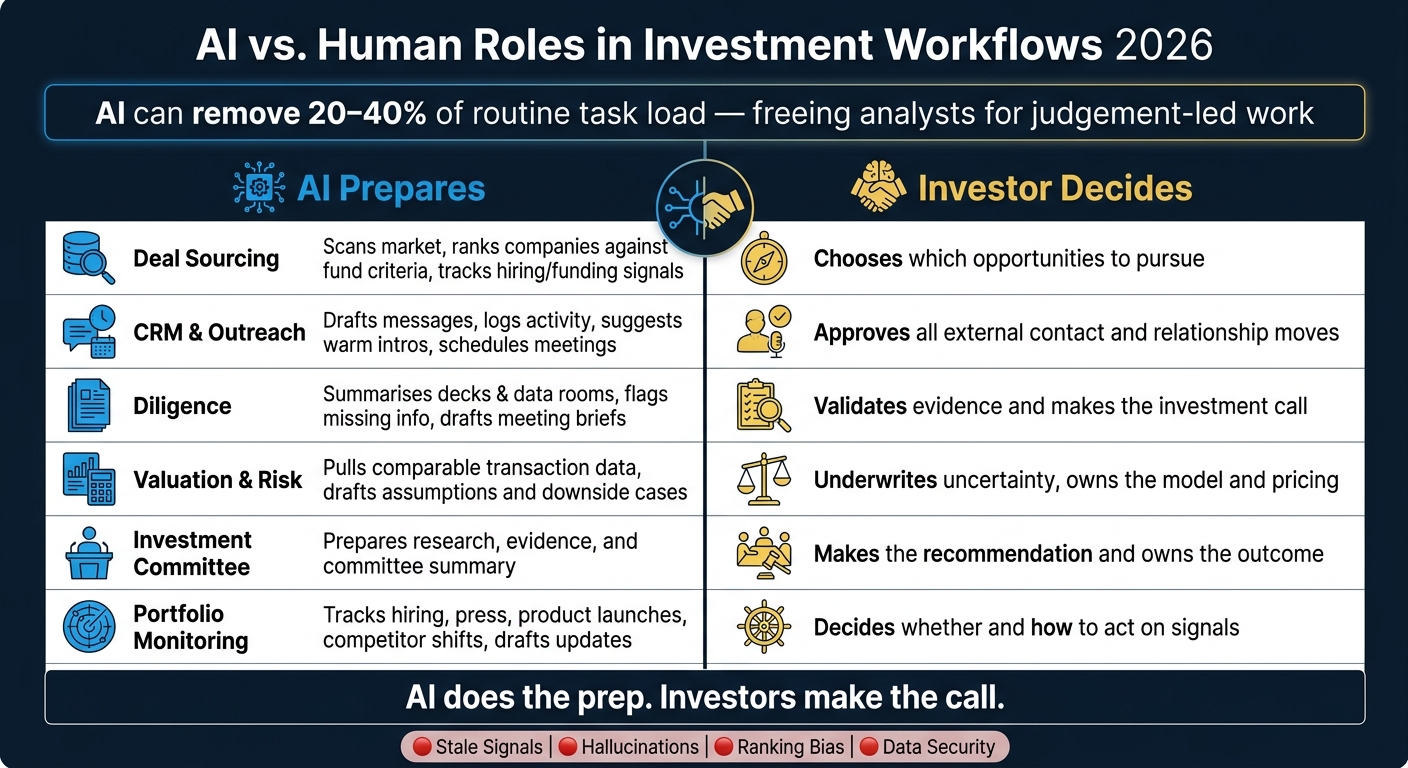
A useful way to think about it is this: AI does the prep; investors make the call. That split matters because investment teams are often buried in manual work. If AI can take even 20% to 40% of that load off routine tasks, a team can spend more time on judgement, founder meetings, and risk.
Here’s the article in one quick view:
| Area | What AI can do | What people still do |
|---|---|---|
| Sourcing | Scan markets, rank companies, track signals | Pick which companies to pursue |
| CRM and outreach | Draft messages, log activity, suggest warm intros, help schedule meetings | Approve contact and relationship moves |
| Diligence | Summarise decks, flag gaps, draft briefs | Check evidence and decide |
| Portfolio work | Track hiring, press, launches, and competitor moves | Decide whether action is needed |
| Risk and valuation | Pull comps and draft assumptions | Own pricing, downside, and committee accountability |
The article’s main point is not that AI replaces analysts. It’s that it shifts analysts away from repetitive production work and towards judgement-led work.
That’s the frame I’d keep in mind before reading the rest.
AI vs. Human Roles in Investment Workflows 2026
What AI can reliably do across the investment workflow
Deal sourcing, market mapping, and founder signal tracking
Once the workflow is under control, the first upside is simple: more coverage. AI scans the market against your thesis, surfaces matches, and ranks them for review. Funds using this setup report much broader deal coverage.
It follows clear signals, such as headcount growth, hiring patterns, funding updates, founder backgrounds, and prior exits. It can also spot whether growth points to traction or just more hiring. That ranking is support for prioritisation, not a verdict on quality.
Once those opportunities are surfaced, the next choke point is usually record-keeping and follow-up.
CRM updates, outreach, follow-ups, and meeting scheduling
AI can pull from email, calendar, and CRM notes to keep pipeline records up to date. Relationship history stays linked to the opportunity: who knows the founder, when you last spoke, and what was discussed.
Avyn ranks opportunities against the thesis, finds warm paths, and drafts outreach in the fund's voice. It also handles meeting scheduling from start to finish. External contact still needs manual approval. AI prepares; the investor approves.
Diligence support and portfolio monitoring
AI can summarise decks and data rooms, flag missing information, and draft meeting briefs before the call. For portfolio companies, it can draft monitoring updates based on headcount, press, product launches, and competitive shifts.
Those drafts still go to the investor for review before anything is recorded or shared. AI-generated summaries are drafts, not source of record.
This gives the team more coverage and more speed, but judgement still drives the investment decision.
sbb-itb-c96cd03
Where human judgement still matters
Thesis, founder judgement, and relationship strategy
AI can spot patterns. But it can't set your thesis, size up a founder, or choose the right relationship move.
Deciding which markets to go after, which trade-offs you can live with, and which founders are worth backing still sits with the investor. AI can pull together signals, but it can't tell you what they mean. A founder may look strong on paper. That doesn't answer the harder question: do they have the context, customer feel, and judgement to make it work?
AI can also find a warm route in. The investor still has to decide whether to take it. That's where the line matters most: when a signal starts turning into a capital decision.
Valuation, underwriting, downside analysis, and investment committee accountability
A strong thesis can still fall apart if the investor gets leverage, liquidity, or downside risk wrong.
For venture debt teams in particular, repayment ability, covenant terms, and downside risk should not be handed over to AI. Those calls need an investor who sees the full risk picture and can stand behind it in front of an investment committee. AI can line up comparable transaction data and point out gaps in a data room. Pricing the risk is a different job.
AI support versus investor ownership: a clear breakdown
The hand-off is the whole point: AI does the prep, and the investor owns the call.
| Task | AI prepares | AI flags for review | Investor decides |
|---|---|---|---|
| Deal sourcing | Scans market and ranks companies against fund criteria | Shortlist with supporting signals | Which opportunities to pursue |
| Outreach | Drafts messages, follow-ups, and warm-path introductions | Proposed timing and contact routes | Reviews and approves before sending |
| Diligence | Summarises decks and data rooms | Missing information and open questions | Validates evidence and makes the call |
| Valuation and risk | Provides comparable data and draft assumptions | Downside cases and gaps | Underwrites uncertainty and owns the model |
| Investment committee | Prepares research and evidence | Committee summary | Makes the recommendation and owns the outcome |
| Portfolio action | Monitors signals and flags changes | Draft monitoring update | Decides whether and how to act |
AI prepares the evidence. The investor owns the judgement, risk, and decision.
That split is what makes the next workflow section practical.
How the AI-augmented team operates in practice
From disconnected tasks to a connected workflow
Once decision rights are clear, the next step is the flow of work itself.
Most investment teams in 2026 still rely on separate tools for sourcing, CRM, outreach, and spreadsheets. That setup creates duplicate work, missed signals, and too much manual data entry when people should be making decisions.
An AI-augmented workflow helps join those pieces up. Say a funding update comes in. A market signal feeds a shortlist, that shortlist prompts drafted outreach, replies update the pipeline, diligence starts from there, and portfolio monitoring keeps running in the background. Instead of rekeying data all day, analysts review exceptions, fix them, and move on.
That said, this only works when approval rules are clear.
Approval rules, controls, and measurable gains
A workflow needs rules just as much as it needs speed. Controls keep AI support separate from investor ownership of risk and capital.
In practice, three levels tend to work well:
- Automate covers low-risk admin work, such as CRM updates, signal tracking, market mapping, and initial company ranking. These tasks can run without intervention.
- Review applies to anything that touches a real person or shapes a decision, such as drafted outreach, thesis-fit assessments, and shortlist rankings. The investor reads the output, edits it if needed, and approves it before anything is sent.
- Decide covers valuation, underwriting, and investment committee submissions. AI supports the process, but investors keep final control over risk and capital.
This tiered model also helps limit model drift. If an investor corrects an AI assessment - for example, spotting that the system is treating headcount growth as traction - that correction should be logged and tested against a separate set of examples before it changes how future companies are scored.
Teams usually track a few clear outcomes: faster review cycles, cleaner CRM data, higher meeting conversion, and shorter diligence turnaround. But those gains last only if the team also keeps a close eye on data quality, bias, and security.
Limits, adoption risks, and conclusion
Data quality, hallucinations, bias, and security
Once AI starts running more of the workflow, the big issue is control: where it breaks, how the team manages it, and what still needs a human sign-off. AI can speed up investment work, but only when it sits inside controlled workflows.
The most common issue is stale signals. Static databases often fall behind real company activity, especially around new company formation. That’s why AI needs to watch earlier signals like hiring spikes, code activity, and stealth incorporations instead of leaning only on static data.
A different risk is fabricated outputs. AI can produce summaries that sound confident and polished, even when there’s no source behind them. The fix is simple: tie outputs to sources. Every claim the system makes - about a founder’s background, a company’s revenue path, or market size - should link back to a source that can be checked. If it can’t, it shouldn’t be trusted without human review. For an investment team, the impact is pretty direct: poor sourcing, wrong outreach, or weak diligence built on claims that don’t hold up.
Ranking bias and thesis drift are harder to spot. If a model keeps scoring companies in a certain pattern and nobody checks why, sourcing can move off course quietly. That’s the danger. Any scoring update should be tested against a separate set of examples before it goes live.
Then there’s confidentiality. Portfolio data, LP information, and deal terms are sensitive. Any AI layer that touches this data needs strong access controls, fail-closed permissions, and audit trails.
What adoption should look like in 2026
The safest rollout starts with low-risk tasks. Use AI where the team can review outputs, fix mistakes, and stop bad actions before anything leaves the system.
| Adoption Problem | Operating Remedy |
|---|---|
| Stale signals | Real-time tracking of hiring, code activity, and stealth formation signals |
| Hallucinations | Outputs tied to sources where every claim is traced to a verifiable source |
| Ranking bias / thesis drift | Test scoring updates against separate example sets before activation |
| Confidentiality / security | Strong access controls, fail-closed permissions, and audit trails |
| Speed without robustness | Require manual confirmation before outreach is sent or meetings are booked |
The real role of the AI analyst
This makes the AI analyst’s role pretty clear: expand coverage, not replace judgement.
AI now handles reading, sorting, drafting, and monitoring. Investors still own judgement, risk, and capital. AI can materially widen deal coverage. The investor still makes the call.
FAQs
What is an AI analyst in practice?
In practice, an AI analyst acts like an always-on analyst for private markets. It keeps scanning the market, learns a fund’s thesis, and scores and ranks companies based on evidence.
Then it takes that context into the next part of the job. It can spot warm intro paths, draft personalised outreach in the firm’s voice, handle follow-ups and meeting bookings, and update the CRM or pipeline as it goes.
The main job here is simple: it takes a lot of the research and admin work that sits around investment judgement off the team’s plate. Human reviewers still check and fix the scoring before any changes are put into use.
Which investment tasks should never be fully automated?
Tasks that call for human judgement or deep context shouldn’t be handed over end to end. Outreach is a good example. Decision-makers can often spot AI-written emails, and that can hurt your professional credibility fast.
AI is well suited to admin work and data processing. But it shouldn’t make the final investment call. Teams still need human oversight for scoring changes and corrections, so AI-led input stays in line with the firm’s investment thesis and shifting criteria.
How should a firm start using AI safely?
Keep AI on a short leash. Check its output against your firm’s investment criteria, and back that up with evidence. Give your team room to fix mistakes, and test any changes to scoring or workflow on their own before you put them into use.
Only switch on reviewed updates after they pass your checks. Feed outputs into your current CRM or pipeline using mapped fields, and require manual confirmation for any action that carries weight. Then review each week which signals are actually leading to meetings.