
Automating Investor Outreach with AI: What Works and What to Avoid
Automate research and admin with AI, but keep human approval — avoid stale data, unchecked sends and generic personalisation.
AI can help investor outreach - but only if I keep humans in control. The short version is simple: I can use AI to find firms faster, sort leads by fit, draft emails, log CRM updates, and stop follow-ups after a reply. But if I let it send unchecked messages, lean on old data, or ignore relationship history, reply rates drop, meetings dry up, and inbox trust falls fast.
Here’s the core point in plain English:
- Use AI for research and admin
- Use people for judgement and approval
- Check signals before contact
- Stop sequences the moment someone replies or opts out
- Track reply quality, not just send volume
- Follow UK GDPR and PECR before doing this at scale
A few clear warning signs tell me an AI outreach setup is going wrong:
- emails mention old funding news
- follow-ups keep going after silence or a negative reply
- the CRM misses past conversations
- personalisation is just “I saw your company”
- bounce and opt-out rates start climbing
And a few signals show the setup is working:
- more qualified replies
- more meeting bookings
- lower bounce rates
- lower opt-out rates
- shorter time from signal to first contact
If I had to reduce the whole article to one rule, it would be this: automate repeatable tasks, not relationship calls. AI is good at scanning large datasets and drafting first passes. It is not good enough to speak for the firm without review.
That’s the lens I’d use for every workflow, tool, and message in this space.
Why AI Outreach Fails for Investment Teams
Most AI outreach failures aren’t tech failures. They’re process failures.
The usual culprits are stale data, weak CRM sync, unsupervised sequences, and shallow personalisation - the kind that looks tailored at first glance but falls apart the moment a founder reads it. The damage tends to show up in a predictable order: first reply quality drops, then meeting conversion weakens, and then the firm’s reputation starts to take a hit.
Common Failure Modes and Their Business Impact
The most common problem is generic personalisation. These messages mention a company name or sector, but they don’t explain why now or why this founder fits the firm’s thesis. To a founder, that usually reads as lazy outreach. So they ignore it.
Then there’s inaccurate data. A lot of AI tools lean on lagging databases that haven’t caught up with what’s happening on the ground. If a message congratulates a founder on a funding round that closed six months ago, the signal is obvious: no one checked the facts before hitting send.
The biggest reputational risk comes from unreviewed automated replies. If an AI model answers a founder’s question with a polished but wrong claim about the firm’s strategy or investment criteria, the damage is immediate. And once that trust is gone, it’s hard to win back. AI can sound confident while getting the details wrong. Without a human review step, those mistakes land straight in the inbox of someone the firm is trying to build a relationship with.
| Failure Mode | Likely Consequence | Corrective Principle |
|---|---|---|
| Stale funding or hiring signals | Outreach to companies that have already raised or pivoted | Use data sources with real-time refresh cycles |
| Generic personalisation | Low response rates; perceived as spam by founders and intermediaries | Reference specific thesis fit and relationship history |
| Unreviewed AI replies | Inaccurate claims that damage firm credibility | Require human approval before any reply is sent |
| Disconnected CRM data | Contacting a founder who is already in active discussions with a colleague | Integrate AI outreach tools directly with CRM and calendar history |
| Over-automated sequencing | Repetitive, tone-deaf follow-ups that ignore prior conversations | Sync relationship context before triggering any follow-up |
The answer isn’t less AI. It’s tighter control over where AI is allowed to act.
Why Volume Is a Poor Substitute for Relevance
Sending more messages doesn’t fix weak targeting. It just increases bounce, opt-out, and spam risk.
Private-market outreach runs on specificity, timing, and fit. A message that lands at the right moment, refers to a real signal, and reflects the firm’s actual thesis will usually beat a generic sequence. You can spot the warning signs early: high opt-out rates, AI assessments that can’t be supported when challenged, and drafts that ignore relationship history.
The teams that do this well use AI for research and drafting, not for unchecked sending. That means using it in narrower, safer ways:
- Research
- Segmentation
- Drafting
- Follow-up
- CRM hygiene under human approval
sbb-itb-c96cd03
Where AI Improves Outreach Under Human Supervision
Prospect Research and Segmentation Based on Investment Thesis
AI fits the hardest part of sourcing well: finding the right companies to contact. The goal is scale without losing trust.
The filter should be the investment thesis, not broad market activity alone. AI can scan hiring spikes, pre-announcement incorporations, funding activity, founder updates, and product launches across millions of companies. It can then rank those companies against the thesis criteria.
Some of these signals appear before they show up in standard databases. That’s useful, but it also creates a line you shouldn’t blur: discovery is not diligence.
AI should produce a ranked shortlist. A human should then review the evidence behind each recommendation, not just the score. For example, “rapid traction” might mean headcount growth, not revenue growth. Someone on the team needs to check whether that signal actually matches the fund’s thesis.
Once a human signs off on the shortlist, AI can draft the first touch.
Message Drafting, Timing, and Follow-Ups With Approval Controls
Once a prospect is confirmed as a genuine fit, AI can draft a short first-touch message in the fund’s voice. It should mention the exact signal that triggered the outreach, such as a recent hire or a product milestone. That kind of detail makes the message feel relevant, not mass-produced.
But it should not send anything on its own.
Every factual claim, every recipient detail, and every reference to recent company activity needs human review before the message goes out. One error in a first-touch email can hurt credibility fast. The same rule applies to follow-ups. AI can draft each one, add new context, and queue it for review before sending.
After send, AI can update the CRM and monitor replies without losing the relationship context.
CRM Updates, Reply Handling, and Pipeline Hygiene
This is where AI can add low-risk efficiency.
It can help with:
- logging outreach
- classifying replies
- scheduling reminders
- stopping sequences after a reply or opt-out
CRM integration keeps relationship history in one place, cuts duplicate outreach, and helps keep the pipeline clean. It also creates an auditable record of both automated actions and human actions taken.
Those controls matter only if they lead to better reply quality, more meetings, and stronger deliverability.
What Effective AI Outreach Looks Like in Practice
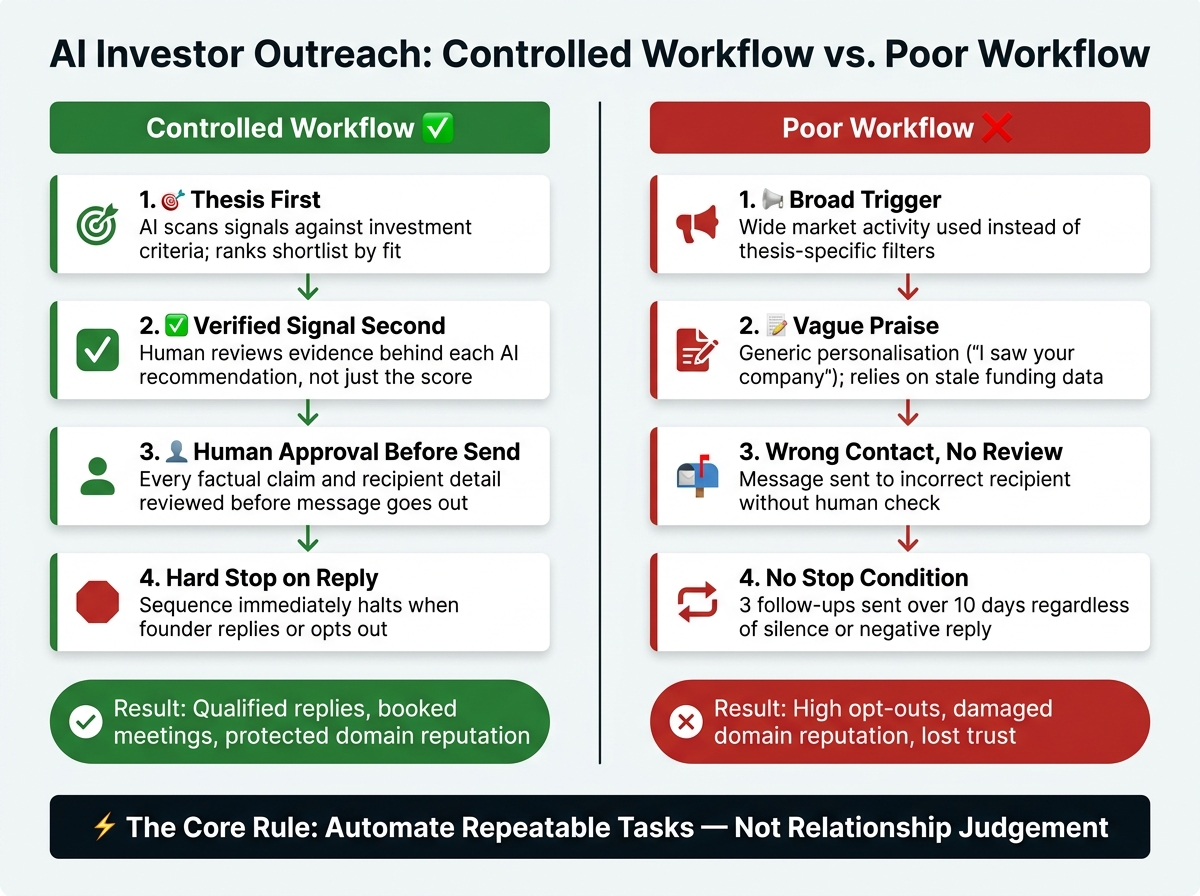
AI Investor Outreach: Controlled Workflow vs. Poor Workflow
The gap between good outreach and bad outreach usually isn't the model. It's how tightly the process is managed.
A Controlled Workflow: From Signal to Meeting
Take a UK-based VC fund that backs capital-efficient fintech startups. Its AI analyst spots a London fintech company that has grown to 40-plus employees while still being founder-owned.
Before a message is written, the system pulls in a note from the CRM: a colleague spoke with the same founder two months ago. That changes the whole approach. Instead of sending a cold, generic opener, the AI drafts a short first-touch message that mentions the hiring pattern, nods to the earlier conversation, and asks a direct question about customer adoption.
Then the analyst checks the evidence. They notice that headcount growth has been given too much weight, fix the assessment, approve the draft, and send it. If the founder replies, the sequence stops.
That's what a controlled setup looks like:
- Thesis first
- Verified signal second
- Human approval before send
- A hard stop on reply
Simple on paper. But it only works if each next step is gated by approval and data checks.
A Poor Workflow: Generic, Inaccurate, and Over-Automated
A weak workflow tends to start with a broad trigger. From there, it writes vague praise, relies on old funding data, sends to the wrong contact, and keeps chasing even when no one replies. Three follow-ups go out over ten days whether anyone has answered or not.
The issue isn't tone. It's bad signal quality, poor context, and no human stop point.
And once there's no stop condition, things can go downhill fast. Repeated follow-ups after silence - or worse, after a negative reply - push up opt-outs and damage domain reputation over time.
Metrics That Show Real Outreach Performance
Raw volume doesn't tell you much. Quality matters more than quantity.
| Metric | What It Indicates | Operational Decision It Informs |
|---|---|---|
| Qualified Reply Rate | Accuracy of the investment thesis and targeting | Refine or pivot the investment criteria and filters |
| Positive Reply Rate | Resonance of the message and value proposition | Adjust tone or the specific hook in outreach drafts |
| Meeting-Booking Rate | Efficiency of converting interest into action | Evaluate friction in the scheduling process |
| Attendance Rate | Quality and intent of prospects being surfaced | Tighten qualification standards before booking |
| Bounce Rate | Health of contact data and domain reputation | Clean the lead list or switch data providers |
| Opt-out Rate | Perceived spamminess or poor targeting | Reduce outreach volume or increase personalisation |
| Time from Signal to Contact | Team agility in responding to market shifts | Automate the research phase to compress lead time |
Each metric points to a different kind of failure.
Low qualified reply rate points to targeting. Low attendance points to weak qualification.
That makes the job much clearer. You can see where controls need tightening before automation is allowed to scale.
How to Deploy AI Without Losing Control
Set Approval Rules, Data Checks, and Deliverability Safeguards
The metrics point to where things go wrong. This section turns those weak spots into clear controls.
Put controls in place at every step where AI could make a bad call.
Every AI outreach workflow needs approval gates at key moments:
- when a new prospect list is generated
- before the first-touch message is sent
- before a reply from a strategic contact is acted on
- before follow-up messages go out
Before any message is sent, check the data underneath it. That means verifying company status, funding claims, and whether growth signals are genuine.
Deliverability needs the same level of care. Use authenticated sending domains, keep volumes sensible, and check the CRM before sending so you don't hit the same contact twice. A clean list and a verified domain protect your firm's reputation just as much as the message itself.
Operational safeguards are only half the job. Legal safeguards matter too.
UK Privacy Requirements to Address Before Automating Outreach
For UK teams, UK GDPR and PECR require a lawful basis for processing, data minimisation, transparency, retention limits, and a suppression list that blocks opted-out contacts before any draft is created.
This is not legal advice. Get qualified compliance guidance before automating outreach at scale.
Conclusion: Automate Research and Admin, Not Relationship Judgement
The rule is simple: automate repeatable work, not relationship judgement.
The best outreach systems automate research and admin, then hand every relationship decision back to a human.
Better outreach comes from sending the right message to the right person at the right moment, with human review where it matters.
FAQs
How much of investor outreach should I automate?
Automate the admin and repeat work, not the judgement.
Use AI for prospect research, segmentation, message drafts, send-time tuning, CRM updates, and follow-up coordination. That’s where it saves time without getting in the way.
But don’t hand over the heart of relationship-building. Generic AI emails can hurt your credibility fast. AI can flag buying signals and suggest warm intro routes, but a person should still review and approve every action before anything goes out.
Which outreach tasks still need human approval?
AI can help with prospect research, draft messages, and handle follow-ups. That said, human approval still matters. It's what keeps your outreach credible and accurate.
Before anything goes out, review each draft to make sure it matches your firm's voice and fits the situation. The same goes for scoring instructions and investment criteria: if those change, your team should check them before putting them into use.
How can I measure whether AI outreach is working?
Audit your pipeline every week and track the full path from signal to meeting. Look at which triggers, like hiring velocity, product launches, or founder moves, keep leading to positive replies.
Then compare those conversion rates against your baseline. That’s how you tell whether AI is improving efficiency, not just pumping out more volume. It’s an easy trap: more activity can look good on paper while results stay flat.
Review your follow-up cadence too. Automated sequences should keep things moving, but they still need to sound human. If messages start to feel stiff, repetitive, or spammy, they’ll lose people fast.