
The Hidden Cost of Manual Investor Outreach
Manual investor outreach reduces coverage, slows replies and weakens CRM data—track speed, response and conversion metrics.
Manual investor outreach costs more than time. It cuts coverage, slows replies, weakens CRM data, and lowers the odds of turning interest into meetings.
If I strip the issue back to basics, the leak usually shows up in five places:
- Discovery: teams miss companies because people can only review so much
- Research: scoring is uneven when each lead is checked by hand
- Outreach: slow or vague messages get ignored
- Follow-up: reminders buried in inboxes and sheets lead to missed touches
- Hand-off: meeting notes and context fail to make it into the CRM
That matters because in private markets, a delay of 1–2 business days can weaken a founder conversation. And when a platform is scanning 35 million companies, a manual team working from shortlists will only see a small share of what is out there.
Here’s the short version:
- Manual work shifts investors away from judgement and into admin
- Each missed step narrows the funnel: fewer companies reviewed, fewer replies, fewer meetings
- Poor data makes it harder to see what is working
- An approval-led AI workflow can remove admin while keeping people in control of each action
A simple way to judge whether sourcing is improving is to track:
- time from company found to first message
- time from founder reply to investor response
- reply rate and meeting-booking rate
- companies reviewed per week
- CRM records with an owner and next step
- hours spent on admin
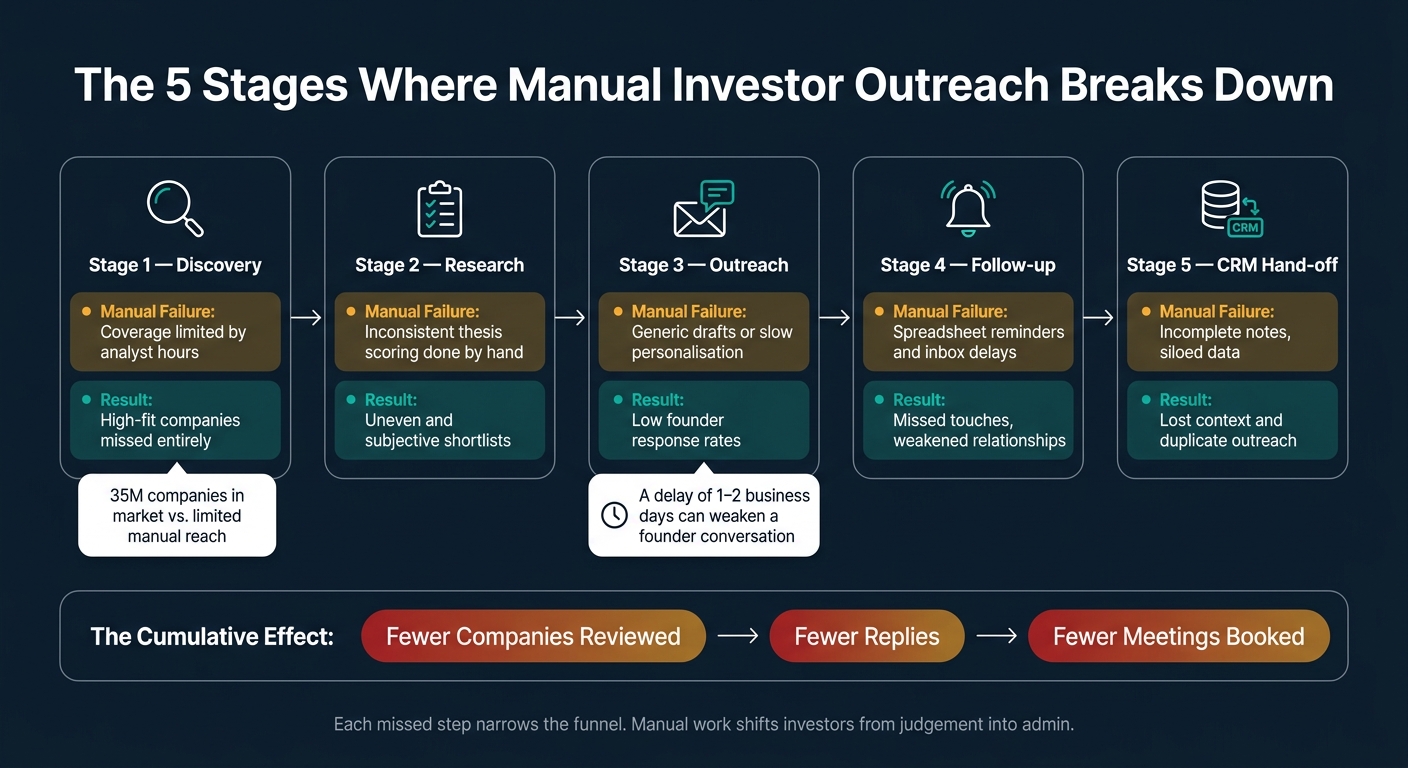
The 5 Stages Where Manual Investor Outreach Breaks Down
Quick comparison
| Area | Manual workflow | Partial automation | Approval-led AI workflow |
|---|---|---|---|
| Market coverage | Limited by analyst time | Broader, but tool-led | Broad scan matched to fund criteria |
| Outreach quality | Handwritten but slow | Template-heavy | Drafted for review with company context |
| Follow-up | Easy to miss | Automated but generic | Sequenced with pause on reply |
| CRM updates | Often incomplete | Mixed sync quality | Auto-updated with context |
| Main risk | Missed deals and admin drag | Spam-like messaging | Too much trust in AI without review |
Bottom line: if you want more meetings from the same team, the first job is not telling people to work harder. It is removing the manual steps that slow them down and make them miss firms they should have contacted.
sbb-itb-c96cd03
Where manual outreach breaks down
How manual sourcing causes missed deal flow
The first weak spot is discovery: teams can only reach what their manual process manages to find.
Manual sourcing falls short because analyst time is limited, but the market keeps moving. If a team leans on inbox alerts or database exports, it only sees part of the picture.
Early signs like hiring spikes, stealth incorporations, and founder moves often show up in public sources well before standard databases catch up. Then manual scoring slows things down again, because each target needs someone to gather proof and judge it by hand. The outcome is uneven coverage and missed early-stage opportunities.
How research, drafting and follow-up slow founder engagement
Once a company is on the radar, the next bottleneck is getting from interest to reply.
Generic outreach gets ignored. Founders spot vague messages straight away, and messages without clear context are easy to dismiss. But writing personalised outreach at scale by hand takes time, and that creates drag.
The problem doesn't stop with the first message. Follow-up tracking is often shaky. Reminders sit in inboxes or spreadsheets, where they're easy to overlook. By the time the next touch goes out, the founder may already have moved on. Across dozens of live conversations, those small misses stack up fast.
The same drag shows up again when a conversation turns into a meeting.
How scheduling and CRM gaps create hand-off failures
Even after a founder replies, things can still fall apart during booking and hand-off.
Back-and-forth calendar coordination adds delays and drains momentum. By the time the meeting is finally booked, that initial energy has often gone.
What gets logged after the meeting is often uneven too. Notes kept in a personal document rarely make their way into the CRM in full. Key details - prior connections, founder context, and next steps - are lost along the way. That leads to duplicate outreach, patchy follow-up, and weaker institutional memory.
| Stage | Manual Failure | Result |
|---|---|---|
| Discovery | Coverage limited by analyst hours | High-fit companies missed entirely |
| Research | Inconsistent thesis scoring | Uneven and subjective shortlists |
| Outreach | Generic drafts or slow personalisation | Low founder response rates |
| Follow-up | Spreadsheet reminders, inbox delays | Missed touches, weakened relationships |
| CRM hand-off | Incomplete notes, siloed data | Lost context, duplicate outreach |
What manual outreach really costs an investment team
These breakdowns turn into a plain operating cost. Manual outreach doesn't just eat hours. It also eats into coverage, slows the team down, and weakens data quality.
Time, coverage and conversion costs
Contact research, message drafting, follow-up reminders, calendar coordination, and CRM entry all take time on their own. Put them together, and they can swallow a big chunk of an analyst's week before any actual judgement begins.
That's where the drag shows up fast. If analysts are tied up with admin, the team reviews fewer companies. Fewer first messages go out. Fewer replies come back. Fewer meetings get booked. And as the funnel tightens at each step, coverage shrinks even more.
The time cost is easy to spot. The relationship and data cost is harder to pin down.
Relationship, data and decision costs
Late follow-up makes the firm seem slow, and that can cut reply rates. Patchy CRM data creates another problem: it hides what's working and what's not. If records aren't clean and consistent, sourcing decisions lean more on instinct than proof. Then pipeline prioritisation slows too.
The aim isn't to remove investor judgement. It's to remove manual entry where it gets in the way.
That's why the operating model matters just as much as the tool.
Manual vs partially automated vs approval-based AI workflow: a comparison
| Feature | Manual Workflow | Partially Automated | Approval-Based AI |
|---|---|---|---|
| Company Discovery | Manual search; limited by analyst hours | Keyword alerts and databases | Thesis-driven; reads the entire market |
| Screening | Human review of every lead | Basic filters; low nuance | AI-ranked against specific fund criteria |
| Contact Research | Manual LinkedIn and web searches | Bulk exports; often outdated | Automated via CRM and network mapping |
| Drafting | Hand-written; slow at scale | Generic templates; easily spotted | AI-drafted in the firm's voice for review |
| Follow-up Management | Spreadsheet reminders; easy to miss | Automated sequences; low personalisation | Intelligent sequenced outreach |
| Reply Handling | Manual inbox monitoring | Basic auto-responders | AI-assisted context and draft replies |
| Meeting Scheduling | Back-and-forth emails | Calendar links | Automated booking and coordination |
| CRM entry | Manual entry; frequently incomplete | Partial sync; creates data gaps | Automated updates with relationship history |
| Pipeline view | Siloed and inconsistent | Dependent on individual tools | Connected and real-time |
| Human Approval | Required at every step | Required for setup | Required before every action |
| Main Operational Risk | Missed deals and admin drag | Brand damage from spammy outreach | Over-reliance on AI without review |
How Avyn removes manual bottlenecks
Avyn turns sourcing into one approval-led workflow. That means the team keeps control, but without all the manual hand-offs that slow things down. Each bottleneck above ties to a workflow step that Avyn automates, while still keeping a person in the loop for approval.
Thesis-driven sourcing and AI-assisted personalisation
It starts by improving how firms find and rank the right companies.
Avyn scans market signals on a continuous basis, including funding activity, headcount growth, hiring trends and founder movement, across 35 million companies. It then ranks those companies against a fund’s own investment criteria, rather than a broad filter. This thesis-driven ranking helps firms spot companies that fit their criteria before the market piles in.
Once a company passes the threshold, Avyn drafts outreach in the firm’s voice. It uses company-specific context and relationship history pulled straight from the firm’s CRM. Every draft stays editable until it’s approved. The investment team can review, edit and approve each message before anything goes out.
Sequenced outreach, reply handling and meeting booking
Once outreach has been sent, the next problem is losing momentum.
If a reply comes in, the sequence pauses and the conversation is surfaced for human review. The reply is categorised and shown to the investment team so they can decide the next action.
The final bottleneck is the hand-off from reply to meeting. Avyn moves the conversation into booking, with the full thread attached. So the person attending the meeting has the full picture before they walk in.
Bottleneck-to-capability mapping: how Avyn addresses each manual failure
The table below shows how each manual failure links to the Avyn workflow step designed to remove it.
| Manual Bottleneck | Operational Symptom | Avyn Workflow Capability | Required Human Approval | Metric for Improvement |
|---|---|---|---|---|
| Thesis matching | Missed off-market deals | Thesis-driven ranking across the entire market | Review and correct thesis fit assessment | Coverage rate |
| Personalisation | Low response rates | AI-assisted drafting in the firm's voice | Edit and approve each outreach draft | Reply and conversion rate |
| Follow-up | Dropped leads | Sequenced outreach with auto-pause on reply | Approval of initial sequence logic | Coverage consistency |
| Automatic CRM updates | Incomplete relationship data | CRM integration with automated opportunity updates | Review of relationship history context | CRM data freshness |
| Meeting booking | Scheduling friction after a positive reply | Reply handling and direct meeting-booking workflows | Categorisation of reply for next action | Time to booked meeting |
The outcome is broader coverage, while the team still stays in control.
How to measure whether sourcing is getting more efficient
Metrics to track sourcing efficiency
Once you’ve spotted the workflow gaps, the next job is simple: check whether those gaps are getting smaller. That means tracking speed, consistency and quality from the moment a company is identified to the point a meeting is booked, across discovery, follow-up, scheduling and CRM hand-off.
The table below covers the metrics that matter most.
| Metric Category | What to Measure | What It Tells You |
|---|---|---|
| Velocity | Time from company identification to first outreach | Whether discovery is converting to engagement quickly enough |
| Responsiveness | Time from founder reply to investor response | Whether follow-up is happening before momentum is lost |
| Conversion | Reply rate, meeting-booking rate, qualified opportunity conversion rate | Whether the funnel is converting at each step |
| Coverage | Companies reviewed per week | Whether discovery is reaching enough of the market |
| Data health | % of records with a named owner and a defined next step | Whether CRM hand-off data is reliable enough to act on |
| Admin time | Analyst or associate hours spent on administration | Whether the team's time is going towards judgement or data entry |
Used properly, these metrics help you pinpoint the slowest or weakest part of the workflow. Instead of guessing where deals are getting stuck, you can see it in the numbers.
It also helps to track signal freshness alongside standard funnel metrics. In plain terms, that means measuring how long it takes for a hiring spike, product launch or funding change to make its way into the pipeline. The earlier a firm spots that signal, the more time it has to act before the deal gets crowded.
Conclusion: broader coverage without losing approval control
These metrics make one thing clear: manual outreach leaks time and opportunities in places that are easy to miss. In many cases, the biggest losses happen before a deal ever reaches the desk.
Approval-based automation tackles those failure points directly: missed discovery, slow follow-up, scheduling friction and incomplete CRM hand-offs. At the same time, human judgement stays in the loop. Avyn handles the groundwork by finding companies, drafting outreach, managing sequences, handling replies and booking meetings, while the investment team keeps control over every action. That leads to broader coverage, faster engagement and cleaner pipeline data.
FAQs
How much does manual outreach really cost?
Manual outreach comes with a hidden price for investment firms. It often leads to missed openings, scattered data, slow replies, and patchy follow-ups. And when that happens, deals can die in the inbox.
The cost goes well beyond the time spent on research and generic cold templates. Some firms end up paying as much as £30,000 a year for weak tools that don't source a single deal.
Which outreach bottlenecks should we fix first?
Start with hiring velocity. It’s often the earliest and clearest sign that a company is growing.
Manually checking job boards, news updates, and long email threads is slow and messy. A better move is to pull those signals into one automated workflow first.
From there, focus on companies where multiple signals line up. For example, a spike in hiring means more when it appears at the same time as a new executive hire or a product launch.
How do we automate outreach without losing control?
You stay in control by automating the admin work while keeping investment judgement at the centre. The system helps your team by monitoring, ranking, and drafting. It does not replace decision-making.
Your team still reviews ranked companies against the investment thesis, maps warm intro routes, and edits outreach before anything goes out. That means your firm’s context and expertise stay in charge.